Guest Lecture · UACS · International Teaching Month · April 2025
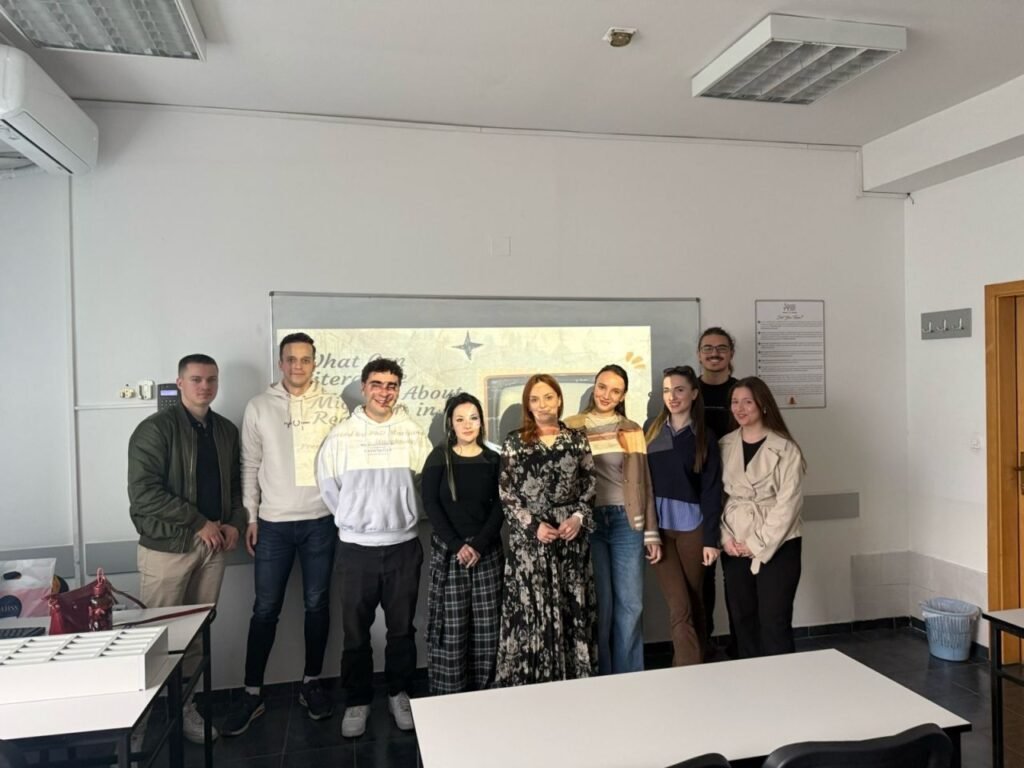
As part of International Teaching Month at the University American College Skopje (UACS), I had the opportunity to join students from the International Organizations course for a guest lecture and discussion on migration.
Rather than approaching migration solely through policies, institutions, statistics and governance frameworks, I wanted to explore another dimension of it, migration as a deeply human experience.
Through literature and science fiction, we discussed what it means to leave, to arrive, to belong, and sometimes to exist somewhere in between.
Migration is, of course, about movement across borders. But borders are only one part of the story. Movement also brings changes in identity, relationships, language, culture and our understanding of home. It involves transition and adaptation, but also negotiation between where we come from, where we are, and where we imagine ourselves belonging.
Science fiction offers a particularly interesting space for thinking about these questions. By creating unfamiliar worlds, imagined societies and different forms of displacement, it allows us to examine very familiar human experiences from a different distance. Questions about migration can therefore become questions about identity, belonging, exclusion, memory and the ways societies respond to those perceived as newcomers or outsiders.
During the discussion, we considered two questions that I find particularly important:
Is migration a problem to be solved, or is movement a fundamental part of the human condition?
And to what extent is our identity inherited, shaped by circumstances, or actively reconstructed through movement?
These questions become especially relevant when migration is discussed within the context of international organizations. Institutions inevitably work with legal categories, policies, procedures and numbers. Yet behind those categories are individual lives and experiences that rarely fit neatly into institutional frameworks.
For me, this is precisely where interdisciplinary approaches become valuable. Literature, speculative fiction and the social sciences do not replace policy analysis. They add another layer to it, one that helps us understand not only how systems manage migration, but also how migration is experienced by people themselves.
I very much enjoyed the conversation with the students and the perspectives they brought into the discussion.
My thanks to Professor Marina Andeva for the invitation and for creating the space to bring this perspective into her International Organizations course.